Mobile Apps have revolutionized the modern world by providing convenience, increased productivity, entertainment, and learning perspectives. Nowadays, all the world’s information is available just a click away which has made people more educated and aware. Including all the major categories, one element through which mobile apps have provided great value to general people is fitness. Fitness has been a section in mobile app stores for quite a while providing health, exercise, nutrition, diet, and sports-related features.
Fitness Apps cover different aspects of health benefits such as regular exercising methods, eating habits understanding, diet tracking, medical record keeping, and so on. Fitness apps are now becoming a part of life for people wanting to maintain balance in their lives. Thus, we are seeing a lot of mobile app development in this niche. This digital transformation has not only helped people improve their quality of life, but has also provided them with diverse self-learning methods without the need of being physically present in a gym with an instructor.
Many businesses and individuals are looking for mobile app development teams for fitness app development. Fitness content is on the rise; therefore, getting a personalized fitness app to cover all essential health needs can guarantee success. If you are looking for the key features of fitness app development, its prerequisites, the development cycle’s flow understanding, and associated cost, read on as all the key details are mentioned in this article.
Types of Fitness Apps
Fitness covers a diverse range of features such as health, diet, exercising, and maintaining good physical habits. This in turn has created a massive range of fitness apps covering specific needs. An app that teaches different sports can be categorized into the fitness category. Similarly, an app containing blogs related to good dietary habits will also be classified in the fitness section. Following is the breakdown of different fitness apps covering specific niches.
Workout and exercise apps
Workout and exercise apps contain audio and video exercising techniques along with detailed descriptions. These sorts of apps ask the user about the kind of workout they are looking for and then provide daily, weekly, or monthly exercise plans according to the criteria selected.
Sports apps are related to different sports and athletic activities and can include features like playing guides, stats, news of ongoing events, etc.
Activity Tracking Apps
The apps that can be used to monitor different body conditions based on certain activities are considered activity-tracking apps. These apps can be used to measure the steps run, distance covered, heart rate, calories burned, and similar kinds of data. Furthermore, these fitness apps are integrated with smartwatches and health monitoring devices for more accurate tracking.
Nutritional Apps
Nutritional apps promote better eating habits by breaking down the nutritional content of food intake. These apps can be used to create diet plans and gather information related to different foods.
Lifestyle Apps
Lifestyle apps are similar to nutritional apps but they also include information related to different health sectors such as training benefits, therapy, yoga, etc.
Personal Trainer Apps
Personal trainer apps are used to virtually connect with gym instructors and fitness consultants to attend exercise classes, get help with your fitness, and do regular fitness keeping. People who prefer to exercise in their own space along with companions usually use these personal trainer apps.
Fitness Store Apps
These are the online marketplaces that are used to sell and buy fitness and healthy diet-related items such as gym equipment, supplements, nutritional food, etc.
App Store and Google Play Store contain tons of fitness apps providing health-related content. However, some of the best names in this regard include Nike Run Club, Apple’s Fitness and Health Apps, Fitbit, and Freeletics.
Features of Fitness App
Fitness apps can cover features ranging from managing the user profile to recommending exercises. Each fitness may differ depending upon the features a business is looking to offer in the app. Some of the keys features that most fitness apps offer together or individually as separate apps include the following.
User Management
User management ranges from creating a user profile, signing up, logging in, etc. to handling personal data. For fitness tracking and other health-related benefits, user management can also include user profiling by storing weight, height, calorie intake, and other parameters. Similarly, for a personalized experience, the user management section in the fitness app can also include goal settings, exercise reminders, rewards and achievements unlocked based on exercises, and so on.
Workout and Exercises
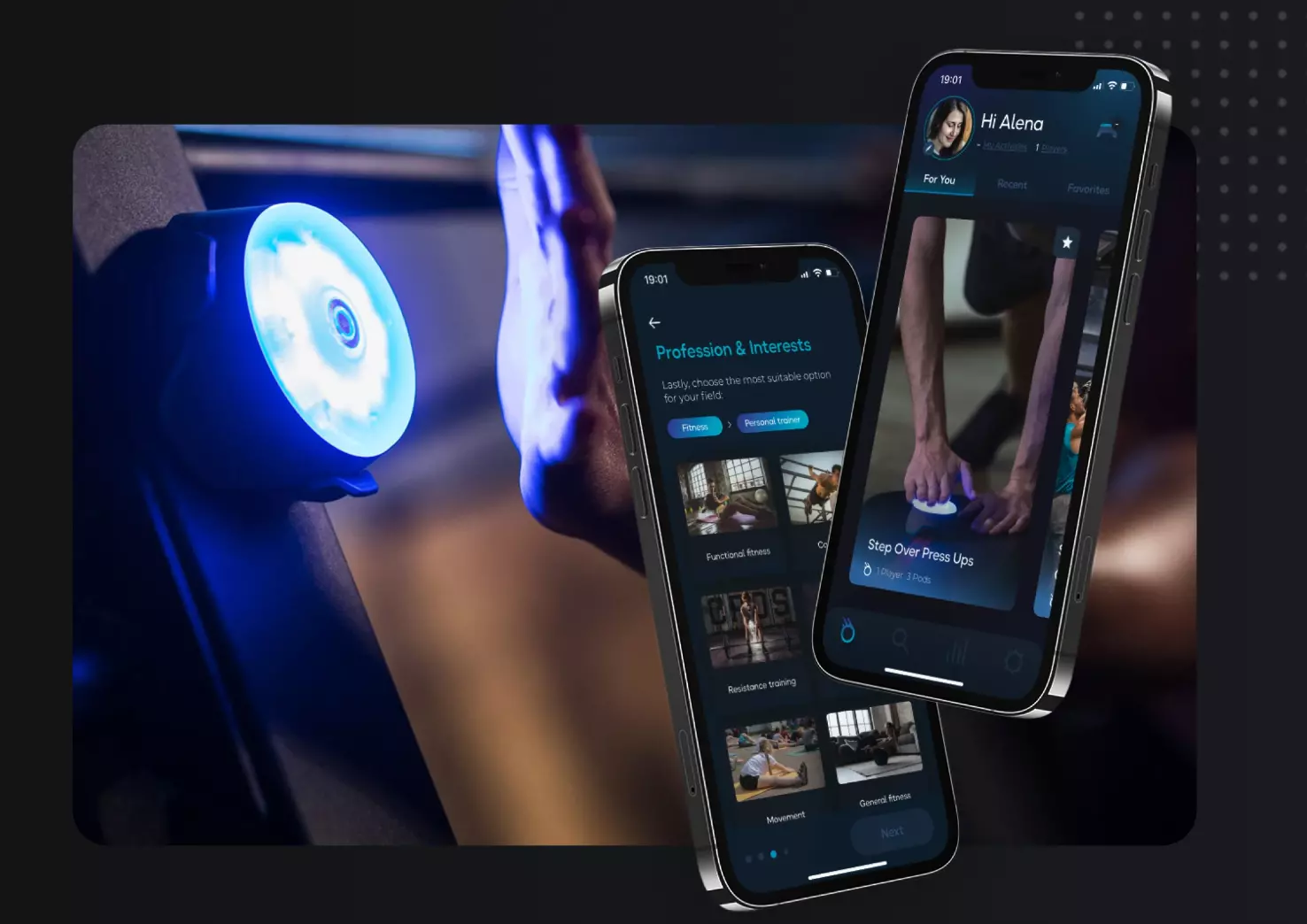
Most fitness apps are linked directly with workouts and exercises. Acting as the core functionality of the fitness app, the workout and exercise section contains the chapters, guides, lists, and complete modules of exercises related to different body parts. Additionally, different exercises for general training, muscle building, fat burning, or core can be found under the specific sections.
These workout apps should be usable for all users of different shapes. Therefore, a difficulty level of workout can also be added under the hood. To be more user-friendly, exercises can be depicted in the video or step-wise image format. Some other prominent features can include time-tracking for workouts, a calendar and reminders for workouts, and a notetaking module.
Maps
For fitness applications dealing with outdoor activities such as running, jogging, athletics, or sports, including maps can play an integral role as it adds a lot of interactivity and is helpful for the user to understand his/her capabilities. Various running apps include maps to show users the area covered along with different stats for a better understanding of personal abilities.
Notifications
Fitness apps must include notifications for users to maintain a constant exercise routine and strict schedule. Along with the exercise timing notifications, goals, rewards, and new exercises can be depicted in notifications to keep the user engaged.
Third-party Integrations
Although fitness apps themselves are enough to cover the basic needs of a workout, several third-party integrations such as music, lyrics, maps API, etc. can act as an add-on to keep the user’s expectations high. Similarly, social media integrations can be included for users to upload exercise stories, and photos, and share posts of different platform timelines.
Nutrition Intake Management
For fitness apps providing health-related content, several modules such as diet plans and calorie calculators can be included.
Health-Related Content
Apart from providing exercise and workout features, fitness apps can include a blog or content section to regularly add fitness-related content. With the help of proper consultation, articles related to exercise, diet, and health benefits can be introduced to increase the fitness knowledge of fitness app users.
Starting from developing the idea of the app to sharing it with the users, fitness app development involves several steps. For a business currently new in this niche, it can be difficult to understand the essential elements and follow the complete software development lifecycle for a successful app completion. Thus, a business can follow the underlying points to create a fitness app.
Market Research
Before starting the development work for the fitness app, it is essential to do market research. Ideally, the fitness app to be developed has to solve a particular problem or provide some extra productivity or engagement features as compared to other fitness apps in the market. Fitness apps have a lot of competition therefore getting to know the details of different apps along with the features and characteristics offered can be beneficial. Finally, getting the know-how of what kind of app the client wants can also increase the success of the app.
For market research, a business can download and use related fitness apps. In the second step, the requirement analysis of the fitness app can be done and the scope of the app can be defined with the client. After locking all the requirements for the app, the fitness app development step can be started.
Prototype Development
In the prototype development step, a minimally viable product can be developed for the client to understand the app flow. The designer of the app can create low and high-fidelity mockups and frontend and the developers can work on basic frontend and backend functionality for the client to understand the functionality. It is essential to know that for prototyping, the high-priority features should be prioritized as they should be developed first.
Choosing the Right Tech Stack
After completing the prototype of the fitness app and getting the final approval from the client, the app development team can move on to select the right tech stack for the app. In this section, the decision to select a native or cross-platform app development framework can be made depending on the market to cover. If the app includes basic features and needs to be developed in a limited time, it is better to select cross-platform. However, for a highly complex mobile app covering tons of features and third-party integrations, native app development languages such as iOS and Android should be selected.
Once every configuration and management stuff is finalized, the app development cycle begins. The complete app is broken down into chunks of tasks and is divided into sprints for developers. In this way, the fitness app features can be released at regular intervals. Also, client input, demos, and retrospective meetings can be arranged to make sure that the expectations are managed throughout the mobile app development process.
Quality Assurance, bug fixing, and testing also run in parallel with the development cycle. In this way, the app modules can be bug-free and timely delivery of the project can be expected.
Release and Maintenance
Once the mobile fitness app completes its software engineering cycle, the release, and maintenance phase begins in which the app is deployed on the store, and in case of any issues, accurate maintenance is guaranteed.
Fitness App Monetization Method
A growing fitness mobile app requires an appropriate combination of monetization models to generate revenue for the business. Considering the flow of the app, different monetization techniques can be used such as including different types of ads in the fitness app or providing in-app purchases. For fitness apps to follow the best monetization strategies, brief details are given below.
Paid Apps
Fitness apps can be made available on the app stores at a little cost. There are plenty of people who prefer to buy a paid fitness app just to get the best guides, workout sections, exercise plans, and so on. Considering the value that the fitness app has to offer, a business can publish its app at a specific price.
Advertisement
Although paid apps can be a monetization option, the chances of reaching success with this method are really low. It is because most people are looking for free apps providing similar value. Thus, the second and the most popular form of monetization model i.e. advertisements come in. Advertisements come in different forms and can be handy when it comes to generating revenue. Ads can be placed as banners, pop-ups, video forms, Interstitial, and rewards however, it is to be made sure that they are not interrupting the normal flow or functioning of the workout steps. Waiting for apps to skip in between exercises can be daunting thus advertisements need to use carefully.
In-App Purchases
Fitness apps can offer in-app purchases for exclusive workouts, content, and training. People usually go for basic versions of the exercises for general health and fitness. However, in-app specialized content, workouts, and training material can be added at a price for people looking to use the app for extreme fitness.
Subscription Services
Workout apps can provide subscription-based services for audio and video workouts. A business opting for this form of monetization can devise basic, mid-tier, and advanced subscription plans for different groups. Similar to this, a blog or reading material on a monthly subscription can be added to provide value to the users along with monetization for business.
Sponsorship and Collaborations
Many fitness apps are made in collaboration with sports teams, sponsors, fitness brands, and so on. The most popular example to follow in this regard is Nike Run Club. A business can collaborate with a fitness brand not only to monetize but also to promote its app to a vast extent.
In contrast to normal apps, fitness apps are used in quite different manners. People usually use them in their free time or during their workout period for extended durations. Although they can be used for casual reading of articles, usually pre-planned workouts and training sessions take most of the screen time for the app.
Fitness app has a specific target market which includes enthusiastic individuals looking to improve their lifestyle with exercise and health-related content. It can also be popular among sports groups, runners, solo trainers, and health-conscious people.
Although there are plenty of fitness apps already available in the app stores, there is still a market need for fitness-related apps. It is because more and more people are trying to find a way to get fit on their own. In the past, people used to get help by physically going to the trainers and gym instructors. However, in this digital age, people get help from apps in the form of readable, audio, and video content.
The global obesity rate has increased drastically over the past few years. The easy access to junk and unhealthy food has increased the average amount of fat in a normal individual. Thus, easy access to a fitness app can not only help individuals with their weight and other training but can also make them aware of the amount of nutrition and calories required in the body.
Involved costs
Fitness apps can cost to a great extent starting from the idea to serving them in the market. From an end-to-end perspective, a business will need to pay for deciding the idea, development team, hosting, marketing, advertisements, gathering workout materials, and hiring professional trainers. Therefore, it is really difficult to give an exact estimation for the fitness app.
From the above-mentioned costing points, the development steps can cost the most. It is because of the time, productivity, and resource cost. In the software development lifecycle process, fitness can be broken down into designing, project management, developing, quality assurance, and documentation. Some sort of changes required later in the app will also include a new cost.
Related problems
A fitness app can incur many problems in terms of development, deployment, marketing, and design. It is usually seen that integration of third-party libraries in small fitness is not so smooth and seamless. This is because of poor development techniques and inadequate testing.
Most of the issues with fitness apps can start from the front end and design layout. Poor user interface and user experience can make or break the app. Using the right fonts, colors, and styling is necessary to make the app a success, therefore, it is necessary to look for similar designs that the other competitive apps follow.
Sometimes, a fitness app goes too much into the technicalities which eliminate the market needs. The fitness app must provide great value however, market demand should be kept in mind throughout the requirements gathering and development processes.
Another common problem that can occur in the fitness app development process is the selection of the right mobile app development framework. There are many cases where people go with native platforms but later on lack the resources to develop separate apps on Android and iOS platforms. Also, sometimes the selection of a cross-platform framework becomes a problem if native integrated features with complex functions are required. Therefore, an understanding of the fitness app features should be identified first before moving on with the framework.
For a business new in the technology realm, fitness mobile app development can be challenging. Each step mentioned can itself be considered an extremely complex task. With proper consultation with the best development teams, individuals, or companies in the market, the fitness app for the business can become a lifetime success. Therefore, get in touch with the best and most experienced mobile app developers in the market.
Mobile App Development in 2026 The mobile app landscape has undergone a seismic shift over the past few years. What began as a gradual migration from websites to mobile apps has now matured into a full ecosystem where mobile is no longer an alternative to the web — it is the primary computing surface for […]
Mobile App Development in 2023 The demand for mobile app development is increasing day by day because of the rapid increase in the usage of mobile platforms for everyday tasks. This shift from websites or web apps to mobile apps has not only opened up new doors for mobile application development industries but also paved […]
Creating a timeline for mobile app development can be a difficult task to take on if you do not have a definitive app development plan. This is exactly why the first step in creating a timeline should be to establish the goals of the project are and the purpose of the mobile app. Timeline establishment […]